
Driven: Britain’s Motoring Story – Brand new display opening at the National Motor Museum
28 April 2026
My first visit to the National Motor Museum at Beaulieu was on the 20th of December 1976, which, not by coincidence, was my seventh birthday. Naturally, I immediately planned to set up home there and possibly claim the Paddy Hopkirk 1964 Monte Carlo Rally Morris Mini Cooper S for my own. Countless other young visitors must have felt the same emotions.
And this is why I was honoured to be invited to the opening of the National Motor Museum’s new exhibition gallery, “Driven: Britain’s Motoring Story” on the 26th of March. This display tells the story of motoring in the UK, and, to quote their press release:
The £700,000 project was supported by The National Lottery Heritage Fund, Garfield Weston Foundation, the Wolfson Foundation, the Hampshire and Isle of Wight Community Foundation, DCMS/Wolfson Museums and Galleries Improvement Fund, Indigo Blue European, Brookspeed, Caroline Montagu Weston Fund, Beaulieu Beaufort Foundation, Lucas Oil and Marcos Motor Company.
Each of the cars in Driven represents a vital part of the story of UK motoring. It could be the red 1969 Jensen Interceptor, which looks as though it had just emerged from an ITC ‘International Man of Mystery’ series or the Austin ‘Se7en’ Mini. The star attraction of the evening was a Jaguar E-Type Series I roadster on a revolving turntable, conjuring images of the 1961 London Motor Show. Meanwhile, the 1992 Honda Accord by the entrance, especially fascinated me. 34 years ago, one might still hear debates over whether it was a “Japanese car made in the UK” or a “UK car, full stop”.
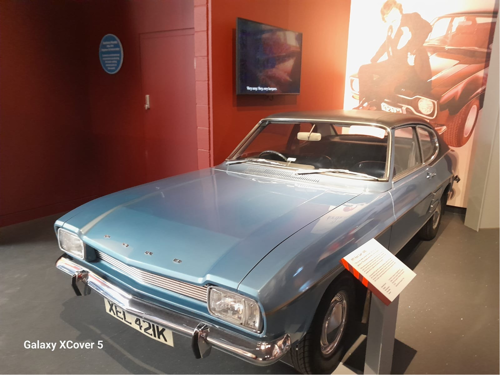
The presence of the Accord was also a reminder of the passage of time – in 1992, an equivalent exhibit might have been a 1958 Austin A55 Cambridge Mk. I. Similarly, a Rover 75 allowed the visitor to appreciate that production ended over two decades ago. Then there was the K-registered Capri 1600L Mk. I, and the idea of such a car becoming a collectable vehicle, would have seemed utterly outlandish to my 1976-vintage self.
As a reasonably horrible child, I regarded such Fords as cars for Southampton wide boys - and for Bill Maynard on Carry On at Your Convenience. Yet, to see the metallic blue example at the National Motor Museum was to once more appreciate how remote the recent past can appear. Not to mention that it was splendid to see an unmodified 1600L, down to its ultra-stylish hubcaps.
The Capri was one of a number of products advertised on screen in Beaulieu’s new Television Lounge rest area. Here, the visitor may relax and regroup; I speak from first-hand experience that it is an excellent facility for those with ASD. There was the chance to read Z-Cars Annual 1963, marvelling at the Ford Zephyr 6 Mk. III and the picture of a fresh-faced Brian Blessed on the front cover. Plus, you can enjoy watching the Brylcreemed lothario hero of the Ford Capri launch film, remember the Milk Tray Man and marvel at how using industrial quantities of hair spray can, apparently, make you look very groovy indeed.
The Rest Area also screened various public information films; Tony ‘Scorates from Bill and Ted’s Excellent Adventure’ Steedman menacingly warning “Only a Fool Breaks the Two-Second Rule”, and the Jon Pertwee-fronted (and incredibly complicated) “Splink!” road crossing campaign. Kevin Keegan, wearing some splendidly flared trousers, advised young viewers to heed the Green Cross Code, and naturally, Dave Prowse saved people from being run over by a Triumph 2000 Mk. II.
Also included was Tufty the Road Safety Squirrel, as famously voiced by Bernard Cribbins, and a seat belt Public Information Film that I can still vividly recall after over 46 years. “Everybody clunks, but not enough people click”, ruminates an off-screen Glyn Edwards, before an Austin Allegro and an Austin Maxi collide. Displaying such films is essential for the Driven display as they are an integral part of the UK’s automotive history.
And throughout Driven, the visitor could interact with past – marvelling at past motoring ephemera, playing the ‘Radio Jukebox’ and viewing the Pathe Newsreel of the M1 opening on a screen above the exhibits. I was also delighted to see clips of the famous 1963 London to Bath driver training film, with its caddish Triumph Herald driver and traffic lights on striped poles. Archive footage of older cars highlights how they looked in their heyday, allowing younger visitors to appreciate how they appeared when new. Beaulieu, of course, has a long tradition of inspiring future classic owners with its Mechanix course, in which 14-17-year-olds restored a 1965 Hillman Super Minx in their spare time.
Perhaps the spirit of Driven was best encapsulated by the television producer and presenter Jon Bentley, who said in his speech at the opening ceremony:
One of the reasons I have so many car memories is that I've worked with cars most of my life, and I remember events not necessarily by the people that were there, but by the car we drove at the occasion!
Every aspect of Driven – the cars, the films, the television advertisements, the road signs – evokes a myriad of memories. This is why I cannot wait to return – even if seeing that 1992 Honda Accord on display makes me feel very old.
With Thanks To: Everyone at Beaulieu