
The Fiat 124 At 60
28 April 2026
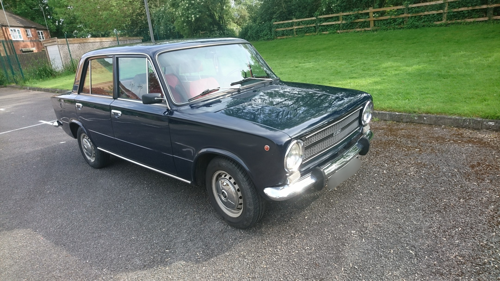
You are looking at one of the most important cars in the history of post-war motoring. Fiat unveiled the 124 in March 1966 at the Geneva Motor Show, and it became a true global car. This very rare example - https://www.carandclassic.com/l/C1727779 - is a reminder of the original Fiat version, as experienced by countless motorists. And to celebrate its anniversary, here are 60 facts:
1) Fiat began work on the 124 in 1963 as the eventual successor to the 1961 1300.
2) Oscar Montabone, who headed Fiat's Automobile Technical Office, was given the brief of an affordable rear-wheel-drive saloon offering more room than the 1300 while being cheaper to manufacture and weighing less.
3) All-disc brakes were very unusual in the 124’s market sector, and unlike the 1300, there was a floor lever for the four-speed all-synchromesh gearbox.
4) Aurelio Lampredi devised a new 1,197cc engine, Fiat’s first four-cylinder unit with a five-bearing crankshaft.
5) The launch sales film saw a Fiat 124 being dropped by parachute.
6) The 124 was Car of the Year 1967.
7) Fiat GB promised a top speed of “nearly 90 mph” in “an extraordinary family car – and “In style, dimensions, and appearance, the 124 is a car entirely in keeping with the contemporary idea”.
8) Eager potential buyers needed to call Fiat GB’s head office on ELGar 1951 for more details.
9) By 1967, the 124 cost £774 5s compared with £693 for a Ford Cortina 1300 4-Door De Luxe Mk. II and £708 for a Vauxhall Viva HB SL90.
10) Reclining front seats were a £7 19s 2d optional extra.
11) November 1966 saw the launch of the 124 Estate - the UK price was £874 8s 7d.
12) Car magazine apparently had Sidney James temporarily occupying the editor’s chair, when it praised how the 124’s body had “no bits hanging off to ruin your trousers or the bird’s nylons”.
13) Fiat introduced the 124 Special in 1968, and its specification included a 1438cc OHV engine with a twin-choke Weber carburettor, four headlamps, servo-assisted brakes, and an alternator.
14) In 1970 the standard 124 saloon and estate gained a brake servo.
15) That year, Fiat introduced the Special T, with the 124 Coupe and Spider’s twin-cam engine in detuned form.
16) For 1973, the Special T was powered by the 132’s 1,597cc engine.
17) Italian 124 saloon and estate production ceased in 1974 and was replaced by the 131 Mirafiori. But the narrative does not end there...
18) On the 1st of July 1965, Fiat commenced discussions with the former Soviet Union and by May 1966, the press reported on a £285 million deal.
19) VAZ - Volzhsky Avtomobilny Zavod - – acquired the manufacturing rights to the 124, and the first examples arrived in the USSR in July 1966.
20) The Soviet government was also considering building the Ford Taunus 12M, the Morris 1100, the Peugeot 204, the Renault 16, and Skoda 1000MB.
21) The 124’s rear disc brakes, ground clearance and bodywork durability proved unsuited to Soviet motoring.
22) VAZ eventually made over 800 changes to the 124’s design and altered 65% of Fiat’s components.
23) Compared with the 124, the VAZ ‘2101’ had two-inch higher suspension, a locally designed 1198cc OHC engine, bodywork made from 30% thicker metal and two-inch-higher suspension, and a starting handle.
24) To better cope with Soviet winters, VAZ fitted a new heater to ensure an indoor temperature of 25 degrees when the thermometer stood at minus 25 degrees outside.
25) VAZ also strengthened the 124’s floorpan and shock absorbers.
26) The 2101 weighed 200lbs more than its Fiat parent.
27) 2101 production began on the 18th of April 1970 - with two red, two white and two cornflower blue examples.
28) The 2101 cost 7200 roubles - the equivalent of three years’ wages for the average Soviet worker.
29) The first 2101s were exported in 1971 – at first to the former Yugoslavia, and then to Finland, the Netherlands and Belgium.
30) 1971 also saw a competition in the car magazine Za Rulem for the 2101’s export name. The publication received 1,812 entries and the winner was Lada (the goddess of beauty, love, joy and youth in Slavic mythology).
31) One rejected entry was Madonna.
32) Italian Lada sales would not begin until the demise of the Fiat 124.
33) RHD production, for Australia, Japan and the UK, commenced in 1973.
34) UK Lada 1200 sales started in May 1974, at a price of £980.83 - “we think the ex-works price should be where your spending stops, not where it begins”.
35) In 1982, VAZ introduced the updated 2107, sold in the UK as the Lada Riva.
36) VAZ made their last version of the 124 platform on the 17th of April 2012 - “A company spokesman told the press: “Demand for the ‘classic’ has dropped a lot. It is time to say goodbye”.
37) Somaca - Société Marocaine de Construction Automobile – assembled the 124 in Morocco.
38) In 1967, Pirin-Fiat of Lovech in Bulgaria began assembling the 124 under licence. By 1971 they made 274 saloons, and 35 estates.
39) 1968 saw the launch of the Malaysian-built 124.
40) That year SEAT of Spain introduced their version of the 124 at the Barcelona Motor Show.
41) The SEAT 124 was priced at under 150,000 pesetas, to appeal to Spain’s emerging middle classes, who needed a saloon larger than the 600 and 850, and smaller than the 1500L.
42) By 1969, the SEAT 124 range included the more opulent 124-L, the Ranchera estate and the more potent 1430.
43) The 1430 was Spanish Car of the Year 1970.
44) SEAT made almost 900,000 124s when production ended in 1980.
45) In South Korea, Asia Motors commenced building the 124 in 1970 as their first car.
46) Local content of the Asia Motors’ 124 amounted to 30 %.
47) Only the 124 saloon was made in South Korea.
48) Assembly ended in April 1973 after 6,775 units.
49) In 1976 Kia Industrial acquired Asia Motors, and the 124 became retrospectively known as the ‘Fiat-KIA 124’.
50) Tofaş - Türk Otomobil Fabrikası Anonim Şirketi - introduced their version of the 124 in 1971. The Murat was named after Sultan Murad I.
51) By 1976, Tofaş replaced the Murat with a locally built 131, but in 1984 they re-started production of the 124 bodyshell as the entry-level 1.3-litre Serçe (sparrow).
52) When Turkish production of the 124 family ended in 1994, sales amounted to 134,867 units.
53) In 1981 SEAT signed a 1,650 million pesetas deal to supply Premier Automobiles of Mumbai with bodies for the 124.
54) Four years later, Premier launched the 118NE in 1985, with power from a Nissan 1.2-litre A12 engine.
55) Premier’s brochure promised the discerning motorist a “dramatic pickup” from the engine
56) Waiting lists for the 118NE could be extensive – six years was not unknown.
57) The last 118NE departed the factory in 2001.
58) As recently as the winter of 2006, Lada Egypt established a $12 million plant in Cairo.
59) The last consignment of Lada kits was despatched from VAZ to Egypt in 2014, and sales ended the following year.
60) Costa Rica, Indonesia, Ireland, Pakistan, Peru, Portugal, Singapore, South Africa, Thailand, Uruguay, Venezuela and Zambia also made the 124.
With thanks to the vendor for his time
With thanks to the vendor for the permission to use the images in this blog.