
1955 Velox Coupe-Utility – the Vauxhall from Australia
31 July 2026
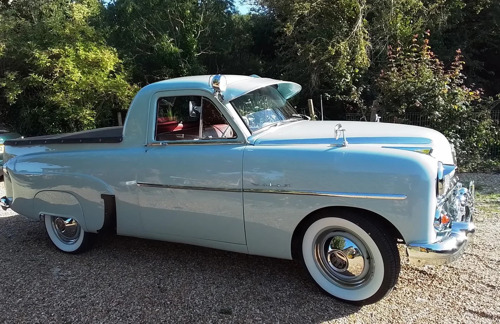
The Utility (or “Ute”) has been an integral part of Australian motoring since 1934 – including versions of British cars that were never offered in its homeland. Shavka Parker's 1955 Vauxhall Velox ‘Coupe-Utility’ is a prime example of the sort of vehicle once seen on farms and in rural businesses from the Northern Territory to Queensland.
As the story goes, the origins of the Australian Ute date from 1933, when Ford received a letter from a farmer’s wife in the Gippsland region of Victoria. She asked: “Can you build me a vehicle that we can use to go to church on Sunday, without getting wet, and that my husband can use to take the pigs to market on Monday?” Ford of Australia’s designer Lew Bandt created the 1934 ‘Model 40-A Light Delivery’, and by the early 1950s, it was virtually essential for a marque to offer a utility model.
Vehicle finance was a strong reason for a manufacturer to create a utility version of a saloon. Laurence Harnett, the MD of General Motors-Holden, reflected that in November 1934, he was approached by an unhappy GM-H dealer who had lost a sale to a farmer. The would-be customer’s bank had a policy refusing loans for passenger cars to farmers with existing financial commitments. However, a vehicle that could assist on the farm was a different matter.
As for Holden, it was originally a saddler that moved into coachbuilding in the 20th century. By 1924, it was the sole provider of General Motors car bodies in Australia. GM acquired the firm in 1931, and by 1948, Holden began production of their own car, the 48-215. They continued to build other General Motors marques -including Vauxhall until the 1960s. The E-Series 1 ½-litre Wyvern and 2.3-litre Velox debuted in 1951, and the General Motors-Holden-assembled versions proved so popular that there was an extensive waiting list.
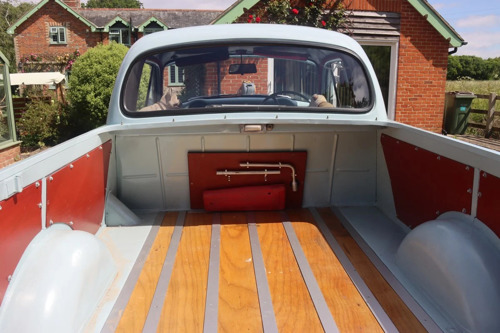
In December 1952, Holden introduced the E-Series models, with no UK equivalents: the Vagabond convertible and the Coupe-Utility. Their fronts were standard Wyvern and Velox, assembled from kits dispatched from Luton, but the rear compartment was designed locally. Aside from stronger rear suspension and a relocated fuel tank, the Coupe-Utility was mechanically identical to the Wyvern and Velox saloons.
The result was “More than just a utility...!”. Instead, the Vauxhall pick-up represented “A new standard of practical comfort and engineering achievement...” One brochure displayed a picture of a Velox Coupe-Utility, with three (very short and slender) occupants on the bench seat. The payload was 10 cwt, and that “Modern Vauxhall Styling” cost a mere £A890 for the Wyvern and £A950 for the Velox.
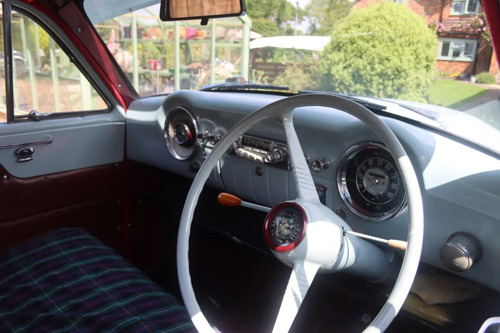
In addition, the discerning customer might specify a “Coolaride Cushion” (“Helps keep you cool and comfortable on hot days”), “Screenclean” washers, and a Venetian Blind from the NASCO accessory list. The National Automotive Service Company, Holden’s in-house parts and accessories division, would impart “added beauty and distinction... enhance your comfort and convenience”. An “Air Chief” radio meant you could listen to the ABC while en route to the station, and a cigarette lighter was apparently “one of the most valuable convenience and safety devices you can have”.
The Vauxhall Coupe Utility’s nearest rival was the in-house Holden Coupe-Utility, which debuted in 1951. There was a waiting list of approximately 70,000 customers during its first year of production, and the Vauxhall models allowed dealers to offer a small range of Utes. The Wyvern was discontinued in 1955 (the Ute market wanted six cylinders), but the Velox Coupe-Utility continued until 1957, when the PA replaced the E-Series Vauxhalls.
And, looking at Shavka’s Velox, who could resist a Ute that you would be “proud to drive on social as well as business occasions”? https://www.carandclassic.com/l/C2059756
With thanks to Shavka Parker for his time.
With thanks to Shavka Parker for his permission to use the images in this blog.