
65 Facts about the Renault 4
31 July 2026
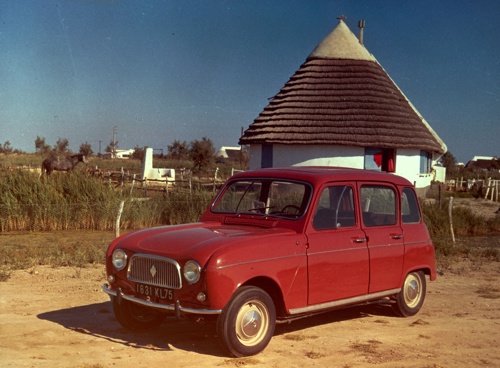
- The 4 was not Renault’s first FWD vehicle as that honour goes to the 1959 Estafette van.
- Renault began work on the R4 in 1956, as a 4CV replacement, and a rival to the Citroon 2CV.
- The company’s CEO Pierre Dreyfus wanted "a versatile car, suitable for both urban and rural use, meeting everyone's needs—in short, a 'blue jeans' car."
- Dreyfus also wanted ‘Project 112’ to cost no more than 350,000 francs.
- The company considered two-cylinder and air-cooled engine options.
- Project 112 underwent tests in the USA to Sweden, Sardinia and Guinea.
- The prototypes evaluated abroad had the code name ‘Marie-Chantal’.
- In March 1961, Renault sent a fleet of lorries containing R4s to a heavily guarded location 34 miles outside of Paris for a dealer demonstration.
- Renault codenamed this top secret dealer demonstration “Opération Soraya”.
- Production of the R4 began on the 3rd of August July 1961.
- The press launch took place on the 26th of August 1961.
- The R4 made its public debut on the 4th of October 1961 at the Paris Motor Show.
- Sales teams were instructed by Renault to inform their “clientele urbaine” of R4’s spaciousness.
- They were further urged to tell their “clientele rurale” of the R4’s durability.
- Further selling points were the sealed cooling system and the fact that the R4 did not require greasing.
- With the rear seat removed, the R4 had room for 50 cubic feet of luggage.
- The R4’s wheelbase was three inches shorter on the left to accommodate the torsion bar rear suspension.
- The early versions had a three-speed gear box from the Dauphine.
- Buyers initially had a choice of three versions. The entry-level R4 had a 747cc engine, no headlining, fresh air vents, painted bumpers ,no rear three-quarter windows, wheel and door trim, or passenger sun visor.
- Best (or worse) of all, the basic R4 has a dipstick attached to the fuel filler cap, rather than a petrol gauge.
- For those who craved more comfort, the R4L (“Limousine”) had all these luxuries, plus a chrome-plated radiator grille.
- The R3 was for motorists who found the basic R4 too exciting, and combined its lack of luxury with a 603 cc engine.
- The colour choices for the R3 ranged from ‘Pyramid Gris’, ‘Pyramid Gris’, or the ever-popular ‘Pyramid Gris’.
- October 1961 marked the launch of the Fourgonette van with a “giraffon” (giraffe hatch) over the rear door to accommodate ladders.
- The “R4” prefix lasted until 1965.
- In March 1962 Renault introduced the R4 Super. By the end of the year it gained the Dauphine’s 845cc engine.
- R3 production ended in September 1962.
- UK sales began in February 1962.
- Early demonstrators wore a sign in the windscreen - “ 'Stop that car - This Is The Remarkable Renault 4”.
- Renault GB promised the buyer space for “children, prams, wives, groceries, husbands, dogs, bags, baggage and room to spare besides”.
- Furthermore, the R4 was “not just a car but a miracle!”.
- British motorists could choose from the ‘Base’ or the L with windscreen washers, rear three-quarter windows, and an interior lamp as standard.
- The R4L further boasted an “anti-theft lock”, a heater booster fan, and “a wealth of chromium trim”.
- The 4L cost £616 13s 1d in 1962, compared with £605 for an Austin Mini Countryman/Morris Mini Traveller.
- Autocar of the 30th of March 1962 thought “it is obvious that no artistic stylist spent sleepless nights pondering on this venture”.
- Not to mention that “to say that it would sell well in the United Kingdom would perhaps be the remark of a real optimist”.
- Motor Sport believed that “for comfort, economy and spaciousness, coupled with freedom from servicing worries, the Renault 4L is remarkable”.
- In 1962 Sinpar (Société Industrielle de Production et d'Adaptation Rhodanienne) of Courbevoie devised a 4WD R4 with modified gear ratios and a larger fuel tank that displaced the spare wheel.
- The R4 Sinpar’s principal markets were the French army, the post office and the Gendarmerie.
- In 1963 Renault upgraded the R4 Super as the R4L with separate front seats and a folding rear bench seat
- On the 8th of March of that year, Renault partnered with Elle magazine for the "She Takes the Wheel" campaign.
- Renault arranged for 20 R4s with special paint finishes to be available in 90 cities across France for 48 hours to 4,200 pre-selected young female readers, who were asked to complete a questionnaire.
- "She Takes the Wheel" was to enhance the R4’s appeal to urban female drivers.
- The result of the campaign was the 4L Super ‘La Parisienne with a distinctive ‘wicker-work’ exterior finish, which debuted in December 1963.
- 1963 also saw the first Spanish-built R4s by FASA - Fabricación de Automóviles Sociedad Anónima de Valladolid.
- By 1966, Autocar seemed more appreciative of the 4, even if they did grumble that it was “singularly lacking in aesthetic merit”.
- On the 1st of February 1966, 4 sales passed the million mark.
- 1968-model cars gained a four-speed gearbox and a new grille.
- Between 1968 and 1970, Sinpar converted 500 4s into the “Plein Air” beach car.
- By 1970, the 4 gained a 12 volt-electrical system.
- In September 1974 the 4 featured a black plastic, rather than metal, radiator grille.
- In 1975 the 4 had an alternator rather than a dynamo.
- Sales passed five million mark” in 1977
- The 1978 4GTL had the 6TL’s 1,108cc engine.
- On the 15th of May 1981, Renault introduced the limited-edition ‘Jogging’, for the French, Belgian and Dutch markets. It was a 4GTL finished in white with a blue fascia, external stripes and sliding roof.
- Renault made 5,000 of the Jogging.
- In 1982 the rear-view mirror was moved from the dashboard top to above the windscreen, when the 4 gained the fascia from the 5.
- By 1983 the 4 had front disc brakes.
- 4 sales exceeded seven million in 1985.
- Over 60% of production was to overseas markets.
- Renault built the 4 in 27 countries.
- French production ended in 1992.
- To mark the end of the 4, Renault built 1,000 of the splendidly named limited-edition ‘Bye-Bye’.
- One reason for the 4’s demise was the need for catalytic converters
- The last of 8,135,424 4s left Renault’s Slovenian plant in 1994.