
Meet The Owner – Julian Kettleborough and his Renault 5L
07 July 2026
Suppose you were seeking a new small FWD hatchback in the 1970s, and the Renault 5 was the top of your list. After all, by 1974, it was the best-selling car in France. The UK advertisements promised “It’s what you’ve been asking for” and so you eagerly pursue the brochure to admire the 5TL in all its yellow glory. Then you notice a white 5 with no suffix that was “well suited for motoring on a limited budget”.
Today, Julian Kettleborough’s privately imported 1975 5L, as it was known in France, is one of the very few on the roads in this country. “She came from a French scrapyard - a friend saw it and messaged me to ask if I wanted to rescue it”. The L had the 782cc engine from the Renault 4, which was only available in France, where government tax/horsepower regulations popularised small-engined cars. The 5L for export markets had the 6’s 845cc unit, which would not be available in France until the 1977 model year, when Renault dispensed with the L badge for the cheapest 5.
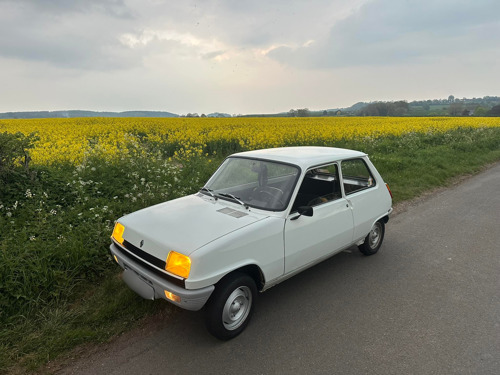
My own experience of the range may be partial, but I cannot ever recall seeing the entry-level 5 in the 1970s and early 1980s. The TL and the GTL with its all-round bumpers, were familiar sights, and occasionally the TS or even the dizzying heights of the Gordini. But the bottom-of-the-range 5 seemed an almost a mythical vehicle, on par with the Vauxhall Viva HB ‘Standard’ with its fixed rear side windows, or the fleet-market Hillman Avenger with its fixed front passenger seat.
Julian describes his 5 as “As basic as it gets, dynamo, front drums, dash gearchange and just 782cc”. It is also a reminder that its equipment levels (or lack of them) were par for the course in the 1970s, down to its single-speed wipers and manual plunger for the windscreen washer. A Renault dealer could also point out that the Mini 850 lacked the 5’s dashboard fresh air vent. By 1978, the UK market brochure proudly cited how the 5’s specification included two-speed wipers and an electric screenwasher.
Besides, the 5 offered the discerning buyer flair and charm for a mere £1,207 in 1975. The Mini 850 cost £1,099 but did not offer the Renault’s three-door versatility, and the £1,094 Hillman Imp was rear-engine, while the prospective 5 owner preferred FWD. Of course, the Fiat 127 looked most appealing at £1,074, and the Honda Civic 3-Door tempting but slightly expensive at £1,284.
However, for the Renault enthusiast, there was no substitute for the 5. Julian’s L highlights the functional yet elegant styling by Michel Boué, with no distracting exterior trim. Naturally, Julian belongs to The Base Model Brilliance Car Club - that does so much to promote these fascinating entry-level models.
After all, a 5 such as Julian’s is, as Renault GB put it, “A car of its time – just as the Mini and the Beetle were in their good times”.
With thanks to Julian Kettleborough for his time.
With thanks to Juluan Kettleborough for his permission to use the pictures in this blog.