
The GAZ Volga M21 – Style and Durability
07 July 2026
Many years ago, I experienced the delights of a 1968 GAZ Volga M21 for Practical Classics. Almost everything about it beguiled me; the green instrument dial, the ivory-coloured switches, the steering column gear lever, the Volga’s air of solidity and its sheer style. Behind the (vast) steering wheel, the M21 felt like a giant-sized Volvo Amazon, which is indeed high praise. In short, I craved a Volga M21 – which is why this 1966 example sold by Barry Daff is so tempting.
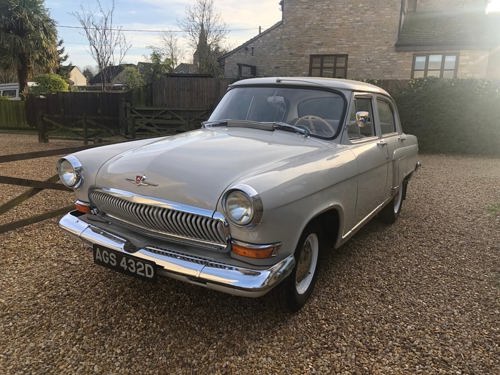
The history of the Volga is well-known; GAZ (Gorkovsky Avtomobilniy Zavod - ‘Gorky Automobile Factory’) planned the M21 to replace their ageing Pobeda M-20. With an eye to export markets, they also bought some Western cars for comparison: a 1952 Standard Vanguard Phase IA, a 1954 Opel Kapitan, and, from the USA, a 1952 Kaiser Henry J, a Chevrolet 210, a 1953 Plymouth Savoy, and a 1954 Ford Mainline. Such a fleet reflected GAZ’s aims for the M21 as a Western currency earner, and a third of their output was eventually destined for 43 countries.
The first Volga left the production line on the 10th of October 1956, with full manufacture starting in December. GAZ facelifted the M21 in 1958 and 1962 with the third generation ‘Baleen’. The last example departed the factory on the 15th of July 1970 after 639,478 units. In its homeland, the M21 was not a car for the average citizen - in 1956, its price of 5,400 roubles was far beyond the average comrade. The Volga’s desirability was a key plot detail of the famous 1966 comedy Beregis Avtomobilya (Beware of the Car).
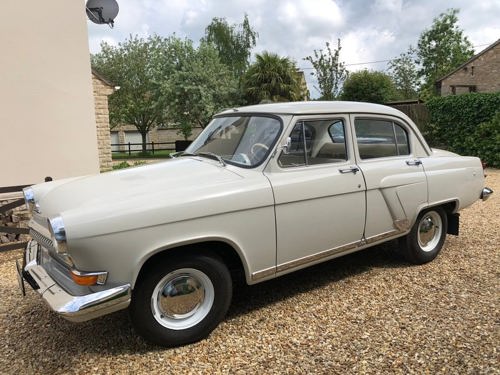
UK sales began in 1959, and by 1966 the M21 cost £914, which was excellent value for money compared with a Humber Hawk Series IV at £960 or a Zephyr 4 Mk. IV at £949. The M21 may have lacked the Ford’s then-fashionable cuboid styling, but the concessionaire Thompson and Taylor emphasised how the M21 was “built for a lifetime of hard work”, and how “Volga do not subscribe to the idea of obsolescence”.
The Volga was also very well-appointed with a radio – a very unusual fitting in that price category, a reclining front bench seat, a radiator blind, and even a hand throttle. One item lacking on the post-1960 models was a pedal to control the built-in chassis lubrication, as it tended to lubricate the road as well. As for power, the 2.4-litre ‘Big Four’ engine was capable of just over 78 mph, but the average Volga owner was more concerned with durability than decadent speeding.
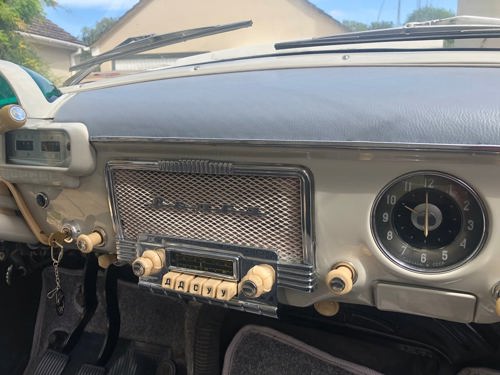
And GAZ designed the M21 when the former Soviet Union had miles of unfinished roads and few service stations. The ground clearance was circa eight inches, and if you were ever stranded, the volcanic heater, starting handle, and 35-piece toolkit were essential items of equipment. The Motor regarded the M21 as “a big and comfortable car of rather leisurely character; it should be very long lived if given proper maintenance”.
Barry’s Volga was restored in Ukraine and arrived in the UK in 2017. Incredibly, the original upholstery shade was still available from the Nizhny Novgorod factory. The exterior also gives it a different image to black-painted M21s that seem to belong in a 1960s Cold War film, and highlights the Volga’s elegance.
And, yes, I am indeed tempted by the car once marketed in the UK as inspiring “the utmost confidence”.
With thanks to Barry Daff for his time.
With thanks to Barry Daff for his permission to use the pictures in this blog.