
Meet the Owner – Ian Hunter and his 1968 Toyota Crown
09 July 2026
Suppose, in 1968, you were in the fortunate position of seeking ‘executive transport’ as you visited the London Motor Show. Your budget is £1,500, so a Rover 2000 at £1,472 is within your reach. Alternatively, there is the Triumph 2.5 PI at £1,450, the vast Ford Zodiac Mk. IV at £1,375 and the equally trans-Atlantic Vauxhall Cresta De Luxe PC for a very reasonable £1,170.
And then, on Stand 95, you notice a rather handsome large saloon. The Toyota marque is not unfamiliar - they have been established in this country since 1965, and there are already 150 outlets in the UK. “And you don’t have to go down a side-street to find them”, boasted one advertisement. “Toyota territory is strictly main-street”.
The S50-Series Crown was Toyota GB’s first import to target the solicitor/chartered accountant market. The price is £1,420, which included a three-speed automatic transmission, tinted glass, quad headlamps, a self-seeking radio with an electric aerial, warning lights for when the rear doors are opened, and even adjustable air extractors for the back seat passengers.
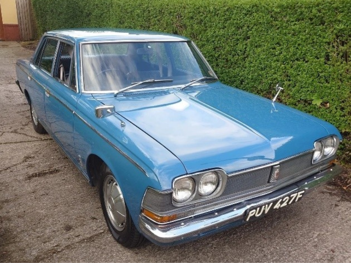
Autocar regarded the Crown as “outstanding value for money”. Motor thought “It seems to us that the only thing that can possibly check its sales here is staunch British suspicion of a new face in a particular traditionalist sector of the market”. This Crown, owned by Ian Hunter, is an actual Toyota GB press car. He inherited from his father, Peter Hunter, the Toyota collector whose name will be familiar to so many readers.
Toyota launched the first-generation 1.5-litre S10, its first full-scale passenger car, in 1955. It was also created in-house, unlike the Nissan-built Austin A50 Cambridge and the Isuzu-built Hillman Minx. Toyota’s aim was to build “the world's best car using only Japanese technology”, and sought the opinion of taxi drivers, one of the Crown’s major intended markets. The design criteria for the new model included robustness, a maximum speed of 62.5 mph, spaciousness, and American-style lines.
Police forces were offered the ‘Toyota Patrol’ - a Crown with a 3.4-litre six-cylinder engine, and in 1960, Toyoglide automatic transmission became an optional extra. Two years later, Toyota introduced the larger second-generation S40-Series Crown, and in 1963, it became the marque’s car sold in Europe, with a small number exported to Denmark. The S40 was also locally assembled in Australia: just one example of how Japanese cars were impacting the Commonwealth export markets of the British motor industry.
The S50-Series replaced the S40 on the 4th of September 1967. The perimeter frame chassis was a departure from previous versions, as was the wider array of colour choices. Toyota wanted the S50 to appeal more to private buyers, who could now order their new Crown in red or white. Before 1965, the government banned these shades on private cars to prevent them from being confused with ambulances and fire engines.
Toyota marketed the S50 as the “White Crown”, and the vast range included trim levels such as ‘Standard’, ‘De Luxe’, ‘Super De Luxe’, ‘Owner De Luxe’, ‘Crown S’, and ‘Owner Special’. Engine choices were a 1,994cc 4-cylinder unit, a 1,988cc 4-cylinder unit, and a 2,253cc six-cylinder OHC plant. Out of this vastly complicated line-up, Toyota GB imported only the 2300 version in saloon or estate car guise. The Crown’s sole Japanese rival in the UK was the Datsun 2000 for £1,407: Nissan commenced British-market sales in 1968.
Toyota replaced the S50 with the S60-series Crown in 1971 after 277,641 units. In Japan, it was a familiar sight: a police car, an ambulance, a taxi, and transport for government ministers and senior managers. In the UK, sales were limited, but the S50 demonstrated to anyone visiting their friendly local Toyota dealership the company’s scope and ambition. In May 1970, total Crown sales passed the one million point.
Today, the Crown is in its 16th incarnation and is Toyota’s oldest brand. Ian’s S50 Toyota Crown is a reminder of why they were so successful.
With thanks to Ian Hunter for his time.
With thanks to Ian Hunter for the use of the images in this blog.